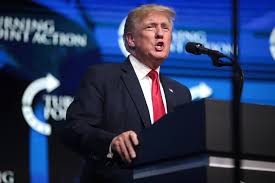
United States: President Donald Trump has issued a sharp warning to Iran, saying the United States would “do it again” if needed — referring to recent airstrikes that damaged key nuclear facilities.
The warning came after Iranian Foreign Minister Abbas Araghchi told Fox News that three major nuclear enrichment sites suffered “serious and severe” damage during US airstrikes in June, though he insisted that Iran’s nuclear efforts would continue.
“It is stopped because the damage is serious,” Araghchi said. “But we will not abandon enrichment. It’s a symbol of our scientists’ work — and now, national pride.”
Trump responded swiftly on Truth Social, his social media platform, writing:
“Of course they are [damaged], just like I said. And we will do it again, if necessary!”
Sites Hit in June Strikes
The June 22 strikes, which occurred during a 12-day Israel-Iran conflict, targeted Iran’s Fordow, Natanz, and Isfahan nuclear sites, according to AP News.
Though Trump later boasted the attacks had “completely and fully obliterated” the facilities, a US intelligence report suggested the impact was more limited — delaying Iran’s nuclear timeline by just a few months.
The White House rejected that analysis, calling the intelligence review “flat-out wrong.”
Iran, Europe Set for Renewed Nuclear Talks
As military tensions remain high, diplomatic discussions are also resuming. Iran announced on Monday it would reengage in nuclear talks with European powers later this week in Istanbul.
The meeting, scheduled for Friday, includes representatives from the UK, France, Germany (the E3 nations), and the European Union. It will mark the first formal dialogue since the US-brokered ceasefire halted the Israel-Iran clashes.
“The agenda is clear: lifting sanctions and discussing the peaceful aspects of Iran’s nuclear program,” said Esmail Baghaei, Iranian foreign ministry spokesman.
Background: The Fragile Nuclear Deal
Under the 2015 Joint Comprehensive Plan of Action (JCPOA), Iran agreed to limit its nuclear work in exchange for sanctions relief. That deal began to fall apart after the Trump administration withdrew in 2018 and reimposed sanctions, as per the reports by the Associated Press.
Since then, Iran has steadily ramped up uranium enrichment, now reaching levels of 60% purity — just shy of the 90% threshold needed for a nuclear weapon, according to the International Atomic Energy Agency (IAEA).
European leaders have warned that unless Iran returns to full compliance, they may trigger the deal’s “snapback” clause, which would restore UN-level sanctions.
Iran Denies Weapon Ambitions
Iran maintains that its nuclear ambitions are purely civilian. Officials deny any plans to develop a nuclear weapon and insist the program is aimed at energy production and medical use.
Still, the combination of US threats, Israeli tensions, and growing enrichment levels continues to push the region into uncertain and dangerous territory — where diplomacy and confrontation now run on parallel tracks.