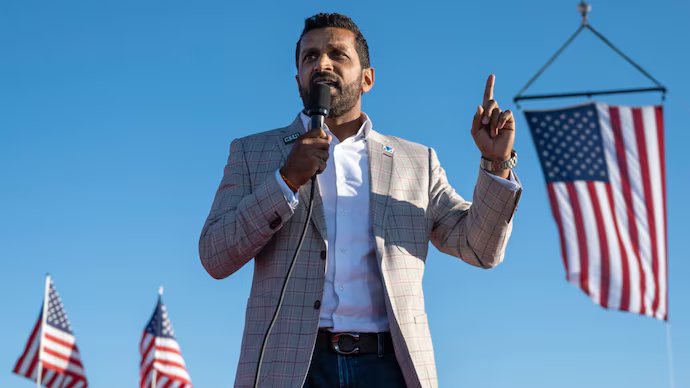
United States: In a razor-thin decision, the United States Senate has narrowly confirmed former federal prosecutor Kash Patel as the new director of the Federal Bureau of Investigation (FBI), adding another turbulent chapter to President Donald Trump’s legacy of polarizing appointments.
The confirmation, finalized on Thursday, eked through with a slim 51-vote majority—exclusively from Republican senators. In a notable act of defiance, GOP Senators Lisa Murkowski of Alaska and Susan Collins of Maine broke ranks, joining all 47 Democrats in a failed bid to block Patel’s nomination, which they denounced as a direct threat to the bureau’s integrity.
“Mr. Patel’s track record is a tapestry of recklessness, incompetence, and profound untrustworthiness,” Senator Dick Durbin of Illinois declared. “Handing him the reins of the FBI is a perilous gamble,” he added, according to Al Jazeera.
Patel, expressing his gratitude via social media, heralded Trump’s unwavering backing and vowed to restore the public’s fractured trust in the FBI. “The politicization of our justice system has corroded its credibility—today, we reset that course,” Patel proclaimed. “My mission is to fortify the bureau from within and reestablish its legitimacy.”
Yet, Patel’s reassurances did little to temper the fierce opposition swelling on the Senate floor before the decisive vote. Critics sounded alarms over Patel’s controversial rhetoric, particularly his previous statements suggesting he might weaponize the FBI against Trump’s political adversaries and the media, raising serious doubts about his commitment to impartiality.
“It’s alarming that my Republican colleagues are willing to sidestep the enormous risks this poses to national security,” Durbin stressed. “I fear history will judge this decision harshly. Giving this man a decade-long command of the FBI is an egregious miscalculation.”
A Confirmation That Broke Tradition
Patel’s razor-thin confirmation stands in stark contrast to the overwhelmingly bipartisan support his predecessors received. Christopher Wray, appointed in 2017, was confirmed with 92 votes; James Comey secured 93 in 2013; and Robert Mueller achieved a unanimous 98–0 in 2001.
While Republicans currently hold a 53-seat majority, Trump’s appointments have typically faced minimal friction. Even Senate Minority Leader Mitch McConnell—who previously rejected high-profile nominations like Tulsi Gabbard and Robert F. Kennedy Jr.—threw his support behind Patel, as reported by Al Jazeera.
Still, dissent within the GOP ranks was undeniable. Senator Murkowski condemned Patel’s overt political entanglements, warning, “The FBI must serve as a bulwark against corruption—not as an instrument for political retribution.” Senator Collins echoed the sentiment, adding that Patel’s “aggressive partisan activism” casts a long shadow over his ability to serve impartially.
Discord Within Party Lines
Patel’s political journey has long been marked by internal friction within his own party. During Trump’s first term, he navigated multiple high-stakes national security roles, but his controversial approach often stirred conflict. Notably, then-CIA Director Gina Haspel reportedly threatened to resign over Patel’s potential elevation to deputy director. Former Attorney General Bill Barr, in his memoir, revealed he had once blocked Patel’s bid for FBI deputy director, reportedly stating it would happen “over my dead body.”
The Hearings: Denials and Defiance
During his contentious confirmation hearings in January, Patel flatly rejected accusations that he intended to reshape the FBI into a political weapon for Trump. “I possess neither the inclination nor the authority to politicize the bureau,” Patel stated firmly.
He unveiled plans to decentralize the FBI’s operations, pledging to redistribute resources away from Washington DC and into regional field offices. “An overwhelming concentration of agents in DC hampers our nationwide reach,” Patel argued. “I intend to place boots on the ground where they’re most needed—within local communities.”
A son of Indian immigrants who fled Uganda before settling in North America, Patel described the attacks on his character as “calculated smears, devoid of merit.” Nevertheless, critics remained laser-focused on his incendiary public remarks and controversial works, Al Jazeera reported.
Patel has previously endorsed conspiracy theories, including the baseless claim that the FBI orchestrated the January 6 Capitol riot as a “false flag” operation. He has also vowed to demolish the FBI headquarters, repurposing it as a “deep state museum,” and has openly discussed targeting Trump’s critics and select media figures.
His children’s book, The Plot Against the King, portrays Trump as a wronged monarch, but it has been widely condemned as political propaganda. Patel’s close ties to the “J6 choir”—a group comprised of January 6 defendants—have only amplified concerns over his partisan affiliations.
Democrats’ Final Stand
Ahead of the vote, Senator Alex Padilla delivered a scathing critique, accusing Patel of leveraging his proximity to Trump for personal gain through media ventures and book deals. “Patel lacks the wisdom, expertise, and objectivity this role demands,” Padilla contended.
Senator Adam Schiff echoed these warnings, cautioning that Patel’s leadership could hollow out the FBI, transforming it into a tool for Trump’s political ambitions. “Law enforcement in a democracy exists to serve the people—not the personal interests of any one leader,” Schiff stressed. “The FBI should be pursuing justice, not political vendettas.”
Despite impassioned opposition, Patel now steps into one of America’s most powerful roles, leaving the Senate—and the nation—profoundly divided over the FBI’s future.