
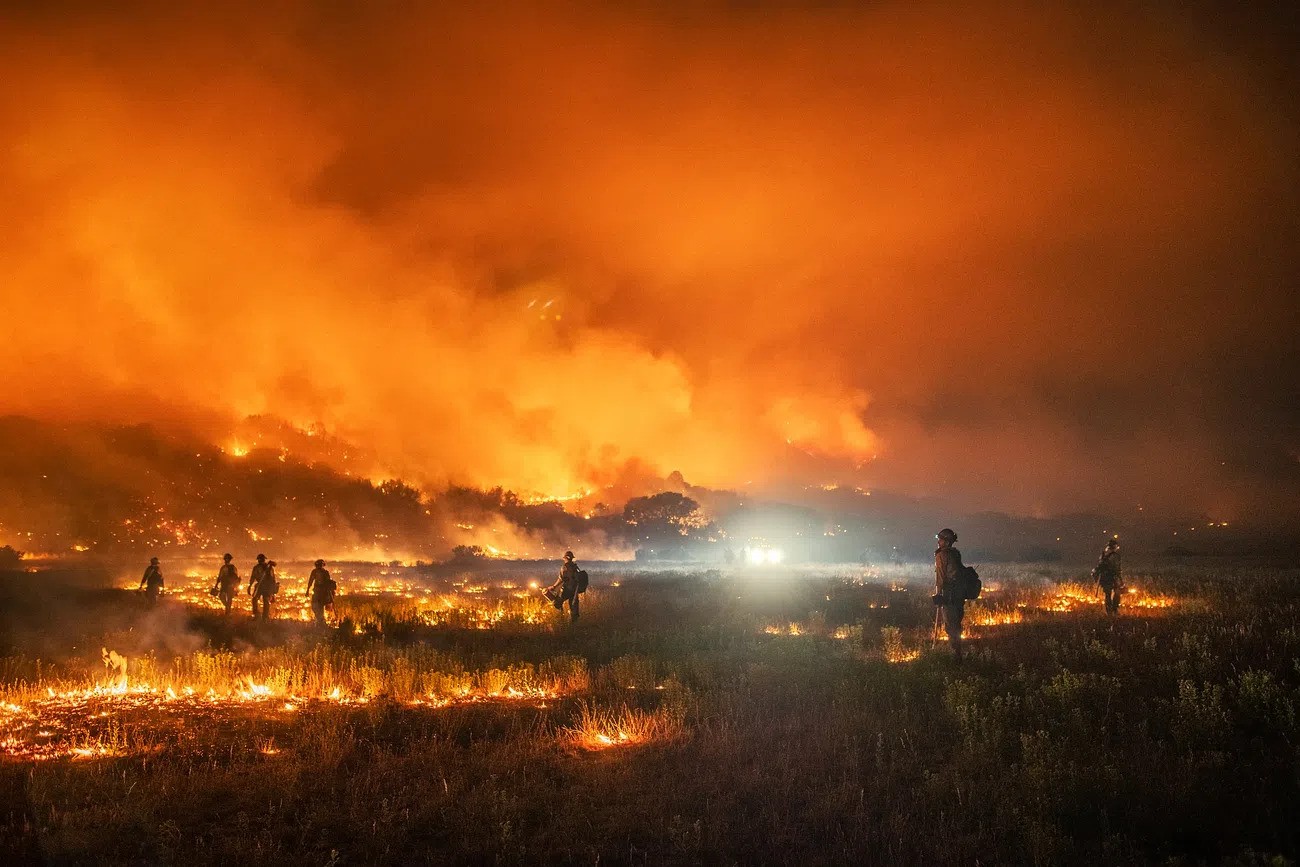
United States: A colossal outbreak of wildfires now devours swaths of western and central Canada, compelling tens of thousands to abandon their homes under the grim prophecy of an apocalyptic fire season. These fiery tempests, rapidly multiplying in a fury, hurl swirls of poisonous smoke into major US metros, clouding skies and stifling air.
The provinces of Manitoba and Saskatchewan have sounded the emergency sirens, plunging into crisis mode as infernos surge beyond containment. From the remote tundras of the Northwest Territories to the heartlands of Ontario, the nation faces a red alert — the pinnacle of Environment Canada’s wildfire danger scale.
According to the Canadian Interagency Forest Fire Center, more than 170 conflagrations are currently alight, with nearly half spiraling unrestrained. Canada has escalated its National Preparedness Level to a dire 5 of 5 — a rarity for this early juncture in the season. Notably, the same status wasn’t reached until mid-July last year.
In Manitoba, evacuations have become a grim norm. Over 17,000 residents have been forced out, including entire communities such as Flin Flon, Pimicikamak Cree Nation, Cross Lake, and Mathias Colomb Cree Nation, according to CBC News.
“This is a chapter of dread and chaos,” confessed Manitoba Premier Wab Kinew, calling it the largest mass evacuation in living memory. The province’s emergency decree stands for 30 days, with the likelihood of prolongation depending on evolving threats.
Chaos intensified in Pukatawagan (Mathias Colomb), where thick, choking smoke grounded flights by dusk Thursday, stranding around 2,000 people. “We’re cornered — hope’s thinning,” said Chief Gordie Bear. Mothers clutched their children. Elders waited, helpless. “I’m terrified,” shared resident Venessa Hart. “How are they even going to get us out now?”
Meanwhile, Saskatchewan mirrors this plight. Thousands there, too, are fleeing, with Premier Scott Moe declaring a provincial emergency for 30 days after pressure from First Nations leaders who voiced grave anxieties about firefighting resources.
“We’re entrenched in a dire storm,” Moe stated during a press conference. “Rainfall isn’t just needed — it’s urgent.”
Scorched Earth and Rising Smoke: The Climate Catastrophe Unfolding
Relentless shifts in the global climate have lengthened the tally of wildfire-prone days and fueled mega-fires that burn hotter, travel faster, and behave more erratically.
Last year, Canada suffered its worst wildfire catastrophe in history, losing over 45 million acres to flames — a direct consequence of unrelenting heatwaves and parched terrain. Now, in a haunting déjà vu, the flames return. Already, 1.58 million acres have succumbed to fire — a number that soars 40% above the 10-year average for this part of the year, according to the reports by CNN.
Saskatchewan and Manitoba alone account for nearly 90% of that devastation, yet British Columbia and Alberta aren’t spared. In Alberta, blazes are flaring with dangerous unpredictability. On Thursday, eight firefighters near Chipewyan Lake found themselves encircled as volatile winds and searing heat magnified the threat.
In just two days, Saskatchewan has lost 250,000 acres. Manitoba, since Sunday, has been swallowed by over 430,000 acres — an expanse twice that of New York City. The Canadian Interagency Forest Fire Center states Manitoba’s land loss is quadruple the seasonal norm.
The aerial pall from these infernos spread across half a million square miles by Thursday — a region twice the size of Texas.
Toxic Shrouds Cross Borders, Polluting American Skies
Forecasting models paint a grim picture: a spectral veil of smoke from western Canadian wildfires drifting south into the Upper Midwest and Great Lakes region. Cities such as Green Bay, Milwaukee, Chicago, and Detroit face hazy, hazardous air days ahead.
This smoky intrusion, hanging low and mid-atmosphere, is set to slash visibility and pollute breathable air. Minnesota has activated an air quality alert for its northern belt, warning of particulate levels deemed dangerous for all, not just vulnerable groups. Similar alerts persist in northern Michigan and across Wisconsin.
On Friday morning, Minnesota’s Arrowhead region registered the worst air quality nationwide.
Lower and middle-altitude smoke could stagnate in the Midwest through the weekend while high-altitude plumes sweep deeper into the Plains. Though elevated smoke doesn’t choke the lungs, it casts a dimming veil across the sun, setting the stage for surreal, crimson sunrises and sunsets, as per CNN.
For millions, the smoky saga is far from over.
Canada’s forecast anticipates a severe fire season far above average. The western United States, too, braces for a summer marked by heightened wildfire potential, as predicted by the National Interagency Fire Center.