
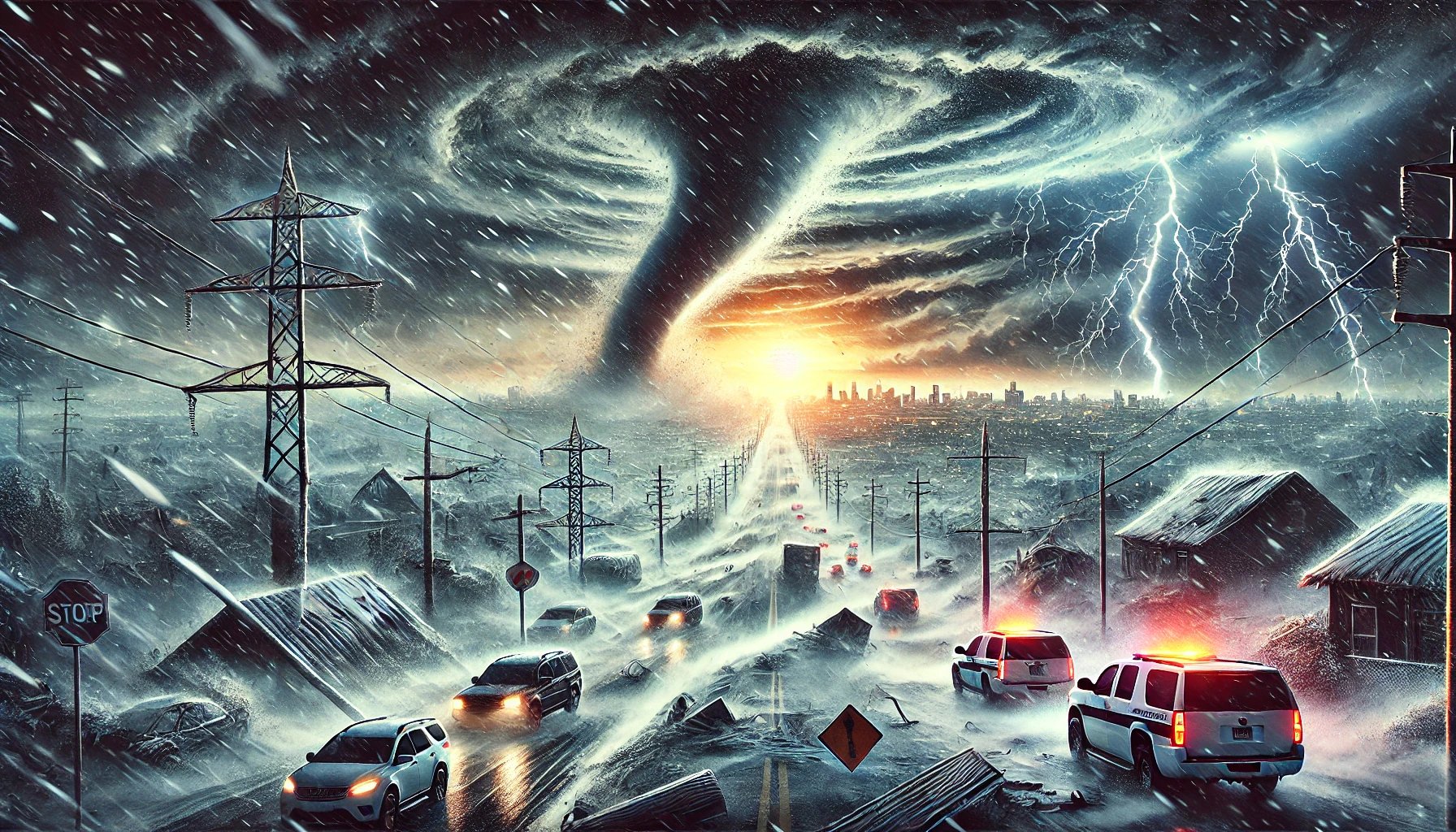
A formidable and labyrinthine tempest has descended upon the eastern sector of the United States, unleashing a maelstrom of unrelenting squalls, obliterating blizzards, and menacing electrical storms for a second consecutive day.
This near-historic meteorological juggernaut, surging with ferocious intensity, made its unwelcome incursion along the East Coast in the early hours of Wednesday, having already carved a swath of destruction through the heartland and southern corridors of the nation on Tuesday. Towering cumulonimbus formations, cyclonic dust storms, and voracious wildfires have left devastation in their wake, punctuating the chaos with calamitous consequences.
Escalating Developments:
Thunderous Onslaught Marches Eastward
Violent convective storms have ignited mayhem across portions of the Carolinas, triggering urgent meteorological advisories, including perilous tornado warnings. As per CNN, the most volatile atmospheric disturbances forecasted for Wednesday pose the dire threat of obliterative wind gusts and the potential genesis of tornadic vortices, stretching from the Carolinas through Virginia and reaching an apex in ferocity by the afternoon hours.
Mounting Fatalities as Storm Turns Deadly
The tempest’s wrath has already claimed no fewer than three lives in Mississippi. Madison County Coroner Alex Breeland reported that one individual met a tragic demise via electrocution, while another perished beneath the crushing weight of a fallen arboreal colossus that smashed into their vehicle. Meanwhile, Clarke County emergency management officials have confirmed the third fatality, further underscoring the storm’s lethal grip.
Devastation in the Storm’s Path
Tuesday’s ferocious atmospheric siege left a trail of annihilation across the southern plains. In Ada, Oklahoma, an EF1 tornado cleaved through infrastructure, uprooting edifices and strewing wreckage, a scene vividly captured across social media. This was but one of at least eight EF1 cyclones that wreaked havoc upon Oklahoma, Texas, and Louisiana. Near Dallas, a warehouse succumbed partially to the storm’s onslaught, while entire rooftops were wrenched asunder, electrical lines eviscerated, and debris strewn across communities.
Widespread Power Disruptions
The sheer ferocity of this meteorological leviathan has plunged more than 400,000 homes and businesses into darkness across over 20 states. As of early Wednesday, Texas alone accounted for more than 100,000 outages, according to PowerOutage.us and corroborated by CNN reports.
Raging Infernos Prompt Evacuations
Tuesday’s heightened fire risk materialized into an eruption of wildfires across Texas. The Welder Complex Fire in Sinton consumed multiple structures and forced emergency evacuations, as reported by CNN affiliate KRIS. Meanwhile, fierce winds in Atascosa County exacerbated residential blazes. Though fire conditions have marginally abated on Wednesday, residual gale-force winds retain the capacity to fan existing infernos. Tennessee, too, has not escaped unscathed, as Sevier County recently lifted evacuation orders, while Monroe County remains under heightened alert.
Blizzard Conditions Engulf the Midwest
The Midwest has found itself entombed beneath a relentless barrage of snow and howling tempests, rendering visibility negligible and travel perilous. By early Wednesday, the Iowa State Patrol had issued dire warnings, labeling road conditions “extremely treacherous.” Dallas County, Iowa, officials noted a significant number of stranded vehicles as blizzard warnings persisted in sections of Iowa, Minnesota, and Michigan. Wind gusts reaching 70 mph compounded the storm’s severity, with Tuesday’s onslaught in western Kansas producing an astounding 93-mph gust recorded in Hugoton.
Apocalyptic Dust Storms Engulf Texas
A Martian-esque shroud of airborne sediment engulfed Dallas on Tuesday as violent squalls propelled billowing masses of red-hued dust across the region for a second consecutive day, a phenomenon captured and reported by CNN.
Perilous Weather Conditions Persist
More than 8 million residents spanning the Carolinas and southern Virginia remain under a Level 3 out of 5 risk for severe convective activity, according to the Storm Prediction Center. Within these zones, destructive wind gusts and the potential for tornadic genesis persist, albeit at a diminished probability compared to Tuesday’s catastrophic outbreak.
The storm’s malignant reach extends well beyond these territories. Over 21 million individuals from Georgia to Pennsylvania—including densely populated urban centers such as Washington, D.C., and Baltimore—remain under a Level 2 out of 5 risk for hazardous weather phenomena. Within these areas, forceful squalls may deliver damaging gusts and isolated tornadoes.
Additionally, deluges of rainfall are poised to inundate regions north of the tempest’s primary trajectory. While widespread flooding remains unlikely, metropolitan hubs such as Philadelphia, New York City, and Boston may experience flash flooding in low-lying and poorly drained zones.
Relentless Winds and Snowfall Compound Challenges
Sustained gales, oscillating between 30 and 40 mph, will continue to lash the eastern half of the nation throughout Wednesday, potentially exacerbating power restoration efforts and amplifying infrastructure vulnerabilities.
While blizzard warnings for the central US and Midwest are slated to lapse by Wednesday afternoon, significant snow accumulations—ranging between 4 and 8 inches—remain likely across eastern Nebraska and southern Minnesota, with wind gusts reaching 65 mph. Wisconsin and northwestern Michigan remain under winter storm alerts through early Thursday, where select locales anticipate over a foot of snowfall coupled with sustained gusts of up to 45 mph, per CNN reports.
Although the storm’s principal precipitation component will wane by Thursday, residual gales will persist, posing continued challenges for recovery and rehabilitation efforts across the afflicted expanse.